They Said Pineapple Helps Implantation So I Tried It After Ovulation
What I actually did, what I felt, what science says—and what no one tells you during the two-week wait.
The reason why I ever attempted such an activity that seems to be folklore. It did not happen out of belief in its effectiveness.
By then, I had already:
- Managed to monitor my cycle correctly.
- Been using ovulation predictor tests.
- Monitored my basal body temperature every day including weekends.
- Scheduled our intimate life in such a manner that it looked more like a schedule than romance.
So, when everyone says, “Just relax,” it does not quite hit home anymore. Because you do know you are trying. Just failing to see the results yet. And it is there that little rituals come into play.
Not because you are stupid. But because you are human.
Where Does This Information Originate From?
The whole “pineapple after ovulation” concept is actually grounded in one thing specifically. An enzyme called bromelain. It’s not made up on the internet.
It can be found mainly in the center parts of pineapples and it is known (clinically) to have:
- Anti-inflammatory properties.
- Blood-thinning effects at very concentrated amounts.
Thus, that is the reasoning behind the whole thing:
- Less inflammation + improved.
- blood flow = better odds of implantation
Makes sense, doesn’t it? Now, here’s the information that I verified before I even started the experiment with pineapple:
- No evidence of pineapple helping with implantation in any clinical studies.
- The concentration of bromelain consumed through eating pineapples is significantly lower than what is medically used.
- Specialists do not recommend consuming pineapple in hopes of conceiving
It is important because: I didn’t adhere to a strict “protocol” found in a blog post. I modified it to fit into something realistic for me to do.
This was how I did it:
- Started in the morning, once I had determined ovulation by using LH strips and temp.
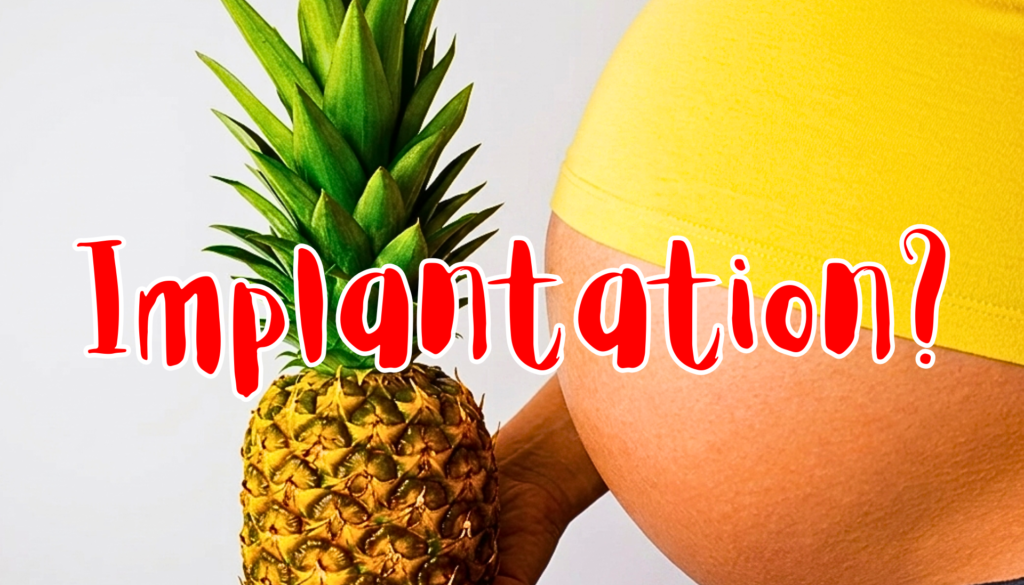
- Purchased one whole fresh pineapple (not canned—less processing and no added syrups).
- Cut it into 5 parts.
- Had one part a day for 5 days.
- Even included some parts of the core, even though I really didn’t like it.
Things I didn’t do:
- Blend it into smoothies to get over the flavor.
- Double my intake because “more is better”.
- Continue beyond 5 days.
Since I have found that when it comes to things not being evidence based: Doubling your efforts isn’t going to help it work any better.
Little Things That Are Not Obvious Until You Try It
Nobody prepares you for the sheer physicality of this process. The meat isn’t just “slightly tough.”
It is so fibrous that: You chew it longer than you thought. It sticks in your teeth. It tastes like food your body has trouble digesting in its natural state.
Your mouth becomes irritated
Day 3: I noticed slight pain on my tongue. There was an unpleasant sensation at the roof of my mouth, reminiscent of the after-effects of consuming too much pineapple.
I needed to gargle water after consuming the food. All due to the bromelain breaking down the protein content, even when it’s from yourself.
Here’s the Difficult Portion
Day 1–2: Low-key optimism
I didn’t expect a miracle. But there was an internal shift: “At least I’m taking part in being supportive.”
It helped alleviate the passiveness of the wait.
Day 3–5: Heightened awareness
Here’s where things got tricky. Because the moment I began my “routine,” I was noticing my body in a different way.
I could feel: Slight tugging in my lower abdomen. Light cramping.
Occasional warmth.
And at that very second, my mind would go into a cycle of: “Could this be implantation?”
But I also remembered (and reminded myself) that:
Those symptoms occur due to progesterone in post-ovulatory phase. They occur during non-pregnant menstrual cycles as well
Thus, I was left in a situation of: Hope and reality check.
The Part That Remains
I tested early. I had told myself I would not. But I did.
Once you begin doing things differently in a cycle, there comes this feeling that perhaps… this will be the time.
And the test came back negative.
Not faint. Not “could be.” Just Clearly Negative.
And it wasn’t just disappointment. No, it was this subtle realization that came over me: “No matter how much I tried… nothing happened.”
Not Just Another Story
I didn’t let it end there. Since I didn’t want one cycle to determine my result.
For the following few cycles:
I did the pineapple treatment once. Did not do it the next time. But paid attention to diet and stress management instead.
The results? They weren’t predictable according to pineapple consumption.
When it hit me: It was something other than pineapple that counted.
What the Science Shows Us
As far as scientific information is concerned: Bromelain works but only when taken in concentrated doses via supplements and not through the normal consumption of foods.
The process of implantation requires: Embryonic quality. Correct hormonal milieu. Proper uterus receptivity. All of which happen due to biological mechanisms—and not because of one single food.
Pineapple isn’t bad. But it certainly isn’t fertility equipment.
The Hidden Error That I Never Knew I Was Making
I said to myself: “It’s just an experiment.”
But on an emotional level, this was not true. For there was a small expectation associated with it. Not a large one, but one which was enough to feel disappointed,
when nothing was achieved.
This is the risk when it comes to such behaviors. They seem innocent. But they escalate expectations.
What Really Helped Me More
After this cycle, I switched gears—only slightly:
1. I stopped giving authority to one food item: In its place, I concentrated on: Regular meals. Iron consumption. Hydration.
2. I considered stress—but practically: Not just “chill out,”
But rather: Reducing nocturnal symptom checking. Improving sleep quality.
3. I did not add too many rituals each cycle: Because all new things become something you keep in mind.
What I’d Tell Someone Considering Giving It a Try
- Not the glossy presentation. The genuine article. If you’re considering trying pineapple:
- Consume it because you enjoy it.
- Skip the core if it makes you uneasy.
- Avoid making it an obligatory part of your protocol.
Since the moment it becomes a “protocol step” is when it inevitably turns into: “I could mess up my chances if I don’t do this.” And that’s a very unhealthy mindset.
The Piece That Others Don’t Want to Voice Aloud
The truth is that most of the information on getting pregnant…
Is not because they work…
But rather due to the fact that:
- They’re not harmful.
- They give people hope.
- And successes are easier to recall than failures
- None of this means people are wrong to spread such information.
However, it does mean: Comfort ≠ Cause
My Candid Response (No Censorship)
Was there any effect of pineapple on my conception? None.
Did it cause any harm? Again, none.
Did it influence my mindset about conceiving? Absolutely.
In Case You Are Reading This During the Two-Week Wait
- You do not require one more rule.
- You do not require one more trick.
- You do not require a perfect pregnancy test in exchange for doing everything right.
Pineapple is not going to assure you anything. Not eating it is not going to decrease your odds.
This is not easy to say, but it is true.
Keeping It Real:
If you have been through this as well, I am genuinely intrigued:
Did you follow one particular way?
Did it help to calm you down or did it stress you out even further?
Can you see how it helped shape your anticipation while waiting?