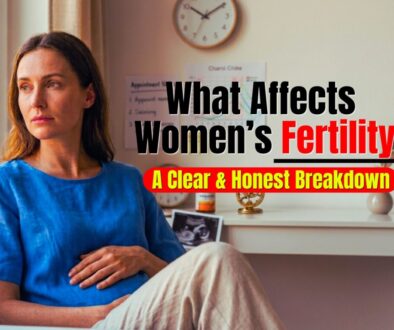

I Spent Months Researching Fertility — Here’s What I Discover
The night I decided to stop trying “casually”.
It wasn’t because my doctor told me to. It wasn’t due to some grand epiphany. It was in the bathroom.
I was looking at yet another negative home pregnancy test, a cheap one bought in bulk because I couldn’t bear wasting money each time. At the time, it felt like: “Maybe I’m just being impatient.”
However, there was something else nagging at me. This wasn’t just a couple of months anymore.
It wasn’t just a few tries. There was an unspoken but expected belief that kept getting reinforced inside of me: That if you were “healthy,” it would all come together seamlessly.
On that night, I began looking on my phone—no longer casually but with determination. And that quickly became weeks… months.
What I uncovered was initially disconcerting. But it was real. The night I decided to stop trying “casually.”
Here’s what fertility means:
There are just a few days out of each month where your chances of conception are high. Not all month long. Not even a little bit. Just 5-6 days total.
Which consists of:
- The 4-5 days prior to ovulating.
- Your actual day of ovulation.
And even then? Your odds of conceiving are around 1 out of 4.
Three times I had to reread that before it sunk in. Because all of a sudden? None of my stress made any sense anymore.
That thing no one wants to talk about (but needs to hear the most)
Age
I put off discussing this topic for many weeks. Not because I was unaware of it—but because I did not want it to relate to me.
But the fact remains: Women are born with their total number of eggs. With age, that number and quality of eggs reduces And this is increasingly evident from around 30 years of age.
Not scare tactics—just biology. But what shocked me even more The other gender is affected too.
Not to the same extent, but still, in a significant way:
- Decline in sperm quality.
- Degradation of sperm DNA.
- This, in turn, impacts fertilization and embryogenesis.
One actual example I heard. There was a couple I followed online for months. Both healthy individuals without any apparent fertility problems. But then they started saying things like this: “We’ll give it another couple of months.” And when they finally went to get tested:
- The woman had low ovarian reserves according to her age.
- The man showed some problems with his sperm motility.
Nothing critical—but enough to cause complications.
But their biggest regret? “We shouldn’t have waited as long before testing—not because there was a problem, but because we wasted time”
The error which cost me the most time: I was assuming ovulation would occur. I did not realize I was making any assumptions.
I was relying on an app. There was a calendar function. It gave me notifications regarding my “fertile window.” It seemed very accurate but It wasn’t.
Why? Because these apps rely on averages—not your specific reproductive biology.
The revelation that shifted things: When I began paying close attention (really paying close attention), I realized:
My cycle length could be quite variable. Sometimes, it varied by several days. My “expected” ovulation date was incorrect.
In one instance, I ovulated almost 5 days later than anticipated. This alone explains many things.
A brief anecdote I found illuminating. This came from a fertility forum thread:
“Thought I ovulated around day 14 for years? Nope, ovulation occurred on day 19. Wasn’t missing fertility, just timing.”
She became pregnant two cycles later. Not because anything “normalized” her reproductive ability. She finally matched her fertility window.
Let’s talk about sperm (which I forgot until I sat down to write this—and that was a bad move)
It was here that I had to question my own biases. I was timing cycles, changing behaviors, studying foods But I wasn’t really considering sperm quality. Not at all.
Something that happens more than you think. Here is the hard reality: Infertility isn’t just about eggs. It’s about what reaches them.
The important considerations about sperm:
- MOTILITY (does it reach the egg?)
- SHAPE (does it fertilize correctly?)
- DNA HEALTH (does it create an embryo?)
One example from my own practice. In one couple, it had taken more than a year. Nothing seemed “off” from a fertility standpoint.
When they did the tests: Their sperm motility scores were poor. They made changes for several months, and it helped. Then they got pregnant.
Without any special supplement. Without a magic secret. Just by acknowledging the problem.
The reality of “fertility hacks” that aren’t really hacks
I’ve tried a few of them. I’m not going to lie. There are special teas “Fertility drinks.” Certain foods eaten at certain times.
They weren’t actually dangerous. Here’s where we get to the real truth, though: They didn’t matter.
Why they seem convincing?
Fertility is unpredictable to begin with. When things work out, the last thing you did seems like the reason.
What actually helped (subtly, reliably)
Boring. Non-viral. Yet true.
1. Sleep: I did not think this would make such an impact.
With erratic sleep:
- Cycle seemed skewed
- Energy decreased
- Life became more difficult
With changes (gradual, flawed): Stability was achieved. Not instantaneously. But clearly.
2. Eating normally (not ideally)
I stopped obsessing about optimizing nutrition.
Rather:
- Three meals per day
- Plenty of protein
- Never skipping meals
No radical eating. No restriction binges. Only stability.
3. Decreasing pressure, not only stress
This is not what “relax” means. Since that suggestion feels dismissive.
What did help:
- Not treating every cycle as high-stakes.
- Not constantly analyzing symptoms.
- Creating room for things beyond trying.
It did not “solve” fertility issues. Yet it made it bearable.
The decision which clarified things the most for me. Getting tested before I expected. Before, I felt like it was a ‘when’ issue.
However, now I understand. You don’t get tested because there is a problem. You get tested to be aware.
What basic tests will tell you, If ovulation is occurring:
- Balances in hormones
- Quality of sperm
- Structural problems
A personal experience that opened my eyes, I was told: “We waited two years assuming everything was okay. Turns out that one of our tubes was blocked. We could have known within months!”
Why was this so meaningful? Because it wasn’t an issue of fear. It was an issue of being proactive!
Emotional aspect that came as a surprise
None of the articles I read could prepare me for that. Because being pregnant is not just an immediate physical condition. But something that alters your perception gradually.
- Where time starts being measured in cycles.
- Where planning anything gets hard.
- Where you start noticing pregnancy-related announcements.
Once I even delayed going somewhere because I thought: “What if I’m pregnant when it’s time to go?”
But that never happened. Yet, the trip did.
Before vs After (What really changed)
Before:
- Ovulation guessing games
- Concentration on myself
- Random tips trying
- Waiting without data
After:
- Knowledge of my real cycle
- Inclusion of all sides of fertility
- Focusing on facts, not on trends
- Informed decisions early
There was nothing magical. Everything just got easier to understand.
If you’re trying at this very moment, here’s all that really counts. Not all of it. Only the essentials:
- Timing matters (not just an educated guess)
- Pay attention to sperm quality
- Consider age, but don’t get hysterical
- Have tests if there’s something that’s not going as planned
- Be persistent rather than impulsive
You don’t have to do everything. You only have to be doing something that works.
Concluding thoughts (the truth no one says)
Looking back, there’s nothing I would change except my own attitude about it. What I’d say to my former self is this: “Get to know yourself first, then figure out how to help yourself.”
The reason is simple. Most times, it isn’t about working harder. It’s about doing things correctly and at the right time. Stop making this such a lonely experience .
If you made it this far, then odds are you’re going through this too. And I would love to hear from you—just not officially, but truly:
- What have you tried that worked for you?
- What advice did nothing for you other than waste your time?
- Are you charting your cycles… or just guessing?
You don’t have to spill your guts. Just sharing one little tidbit can make another woman feel she’s not alone. And some days, that’s all we need.