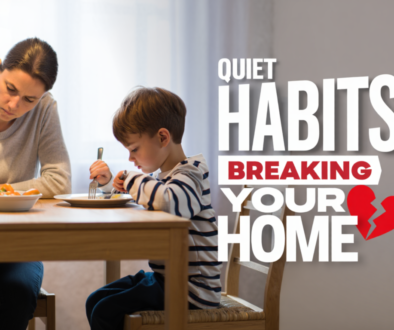

Secret of Creating a Calm and Happy Family Life
(The One Nobody Talks About)
Secret Not Everyone Wants to Reveal. Sometimes, the family becomes a safe haven for you.
Other times, it can be just the reverse. And the funny thing is… it could happen in the same day. You can be laughing around the dinner table… and then fighting over some minor issue such as tone, chores, or misunderstandings.
This is what many keep from posting on social media. A calm family doesn’t lack conflict. A calm family has the ability to handle conflict.
What Peace Really Feels Like (It’s Not All Happiness)
Peace within a family unit is less boisterous than one might think.
It doesn’t mean always laughing out loud. It doesn’t mean always connecting.
Instead, it means: Feeling comfortable sitting together without needing to converse. Understanding that silent pauses are not signs of rage. Believing that you don’t need to “put on a show” for acceptance. Becoming irritated… but never feeling threatened.
It’s hard to see. It’s almost undetectable. When it’s present, you barely notice. When it’s absent, you feel it acutely.
Realistic Day In an Average Family Household
The morning rush begins. Someone sleeps in. Someone gets into a bad mood. Someone has forgotten something significant. Nothing is said with proper courtesy — just brief directions, perhaps an impatient comment that there isn’t any time for.
The afternoon goes by. Everybody remains busy within their own zone. Professional issues. Academic tensions. Personal issues. Then the evening arrives.
Two scenarios emerge from here: Scenario One (What people expect), Relaxed meal, Simple conversation, Mutual amusement, Scenario Two (What normally happens), Short comments, Someone engrossed on a device. Misinterpreted statement. A raised tone. Someone shutting down.
It doesn’t take long for the atmosphere to change. Not because anything was planned — but because everybody had come back home with their load.
The Truth: The Family Arguments Are Not about the Problem
They are never about: The dirty dishes. The loud noises. The undone tasks.
They are really about: I feel like I am not being heard. I feel like I am not appreciated. I am exhausted, but nobody seems to care.
Yet what they say is: “Why can’t you do this one thing right?” That’s what makes the argument. Not the problem — but the way the problem is said.
The Little Things That Really Matter
Everyone believes big actions solve everything. But trust me – it is those little and nearly insignificant moments that define family dynamics. For example:
Asking someone “Have you had your meal?” Sending an impromptu text, “Ingat ka”
Sitting side by side in silence without feeling uncomfortable
Sharing your food even though nobody asks
They do not appear to be significant. However, their absence becomes instantly noticeable.
The Uncomfortable Truth When You Feel “Right”
It is easy to have those moments when you feel that you’re right. And you very well may be. But here comes the difficult truth: Being right doesn’t necessarily lead to improvement. Because sometimes: You end up winning the fight. While your loved one feels insignificant and the gap grows bigger.
Families at peace understand something that most struggle to accept: Some times you need to decide to value the relationship more than being right.
Silence Is Not Always Harmony
This one counts. Some families may be “silent”… but definitely not harmonious. There are no screams,
no apparent disputes.
However, there are also no… no real communications, no emotional connections, no openness.
The silence becomes oppressive than all the fights. Since nothing ever gets sorted out.
Apologies (Those That Matter)
Truthfully speaking, apologizing within your family is not easy. This is because there is always a matter of pride. You would say:
“They should be the ones apologizing.”
“They are guilty too.”
But nothing happens. And the rift widens. However, when someone admits that: “I handled things badly.” A lot changes.
Instantly? No. But there is a chance of reconciliation.
The Side of Parents That You Don’t Know
“Parents” is not just another term used to describe people.
Parents are also: Tired people, Stressed people, Individuals who are trying to make sense of life while guiding others.
Sometimes, parents find themselves: Too tired to communicate effectively. Angrier than they would like. Feeling regretful for their behavior. Yet, most will never openly admit this.
The Side of Children That Is Often Missunderstood
Not all children and teenagers have the ability to say their feelings. Instead of saying:
“I’m overwhelmed.”
“I feel pressured.”
They end up saying: Attitude, Silence, Irritation. Which then becomes a case of “disrespect.” Yes, it can be disrespect. However, some times… it is just pent-up stress.
“Quality Time” Reality
They say: “Take more quality time.” But what is it supposed to mean? It doesn’t always come from planned bonding.
It could be: Watching something together and reacting simultaneously. Eating slowly. Sitting together and engaging in different activities. It isn’t the activity itself but being there for the activity that makes it quality time.
Technology: The Silent Distance
Nobody sees it happen. It takes time. Someone pulls out their phone, then another, and then everyone is occupied.
You’re with people, but you’re not. And gradually, conversations become briefer. Not because you don’t care — just that your focus is shared.
The Hard Part: Reconnecting After a Conflict
This is where many families have trouble.
Following an argument, there is a point where somebody must: End the silence. Drop their guard. Initiate the conversation once more.
And it isn’t easy. Often, it is even awkward. Thus, they hesitate. Then hesitate some more. And the longer they hesitate, the more difficult it is.
Families that remain peaceful don’t shun arguments. They just never disconnect for long periods of time.
How Does One Create a Harmonious Family?
Not through perfection. Not through continuous happiness.
Just through actions like: Checking in despite a difficult day. Being kind during an argument. Choosing to listen rather than react right away. Trying once more despite failing yesterday.
It’s repetitious. It’s subtle. It’s often unseen. But it makes a difference.
A Single Act That Says It All
Picture this scenario: It’s night time. The house is still. There had been some friction before.
Perhaps an altercation had taken place. And then somebody enters the room, and asks: “How are you?”
Not elegantly phrased. Not theatrical. Just plain.
That single act – rather than any guidance – keeps families united.
The Final Thoughts (Make This Real)
Having a peaceful and joy-filled existence at home is not something that you work for once in your lifetime and then you have forever after. No, it involves continuous rebuilding…
And sometimes you succeed, Other times you fail.
But if you just: Show up, Try again, Care enough to make it better. This is enough.
There Is Only One Lesson to Learn from This
Everything doesn’t have to be fixed right away. One small step can make a difference.
Maybe tonight, You reply a little nicer. You listen a little longer. You give up something little.
This is where peace begins. Not grand actions, Just small, human actions… again and again.